cleaning contracts · 12 min read
The ultimate guide to writing commercial and residential cleaning contracts
Learn how to write commercial and residential cleaning contracts that protect your margin, define scope, and get you paid on time. Templates and clause tips included.
Nasim

You walked the property, sent the quote, and won the job. Now your crew is on site, the client keeps adding tasks for free, and your first invoice is sitting unpaid.
Running a cleaning business without a tight written agreement puts your payroll and your margins at risk on every single route.
If you want to protect your crew's time and get paid on schedule, you need a repeatable process for securing the work.
How do you structure a cleaning contract so scope creep doesn't eat your margin?
What clauses do you need for pricing, supplies, cancellation, and renewal?
How do you move a client from a walkthrough bid to a signed recurring agreement?
Read on to build your template and set up your process.
Why do you need a written cleaning contract before the first visit?
You need a written cleaning contract to define your scope, protect your profit margin, and guarantee when you get paid. Without a signed agreement, you leave your business open to four common problems:
Unpaid extra work: When tasks aren't listed room by room, commercial property managers and homeowners will treat deep-cleaning requests as part of the standard visit.
Underbid labor and supplies: ZipRecruiter notes that accurate estimation of labor, supply costs, and time is a common challenge in cleaning bids, and underestimating cuts margins or hurts service quality.
Disputes over chemicals and gear: Many independent contract setups, such as listings from Right Cleaning Done LLC and Red Rock Cleaning, require cleaners to bring their own supplies and equipment, which turns into an argument if the client expects you to restock their paper towels for free.
Sudden route gaps: If a five-night-a-week office account drops you on a Friday afternoon with zero notice, you still have techs expecting hours on Monday morning.
You're right to put a real contract in place before your trucks roll. Even a two-page agreement turns an awkward argument into a simple check of the rules you both signed.
What is the difference between a cleaning bid, a service contract, and a subcontract?
Many operators use these terms as if they mean the same thing, which causes confusion when searching for work or sending paperwork.
A cleaning bid or proposal is the quote you submit to a prospective client that outlines the services provided, the frequency of cleaning, and your pricing. As ZipRecruiter explains, the client reviews multiple bids and picks the best fit for their needs and budget.
A cleaning service contract is the binding agreement signed after you win the bid, adding legal terms for invoicing, supplies, liability insurance, cancellation notice, and renewal. It governs the ongoing relationship between your company and the property owner or facility manager.
A cleaning subcontract or 1099 agreement is a deal where a larger facility company or booking platform hires an independent operator to fulfill the cleaning work. For example, Hello Cleaners requires contractors to work as a 1099 independent contractor or registered business, pass a background check, and carry their own liability insurance, while Little Nest Cleaning advertises flat-rate contractor jobs where the cleaner keeps 60% of the job rate.
What should you prepare before you send a cleaning contract?
Before you draft and send a cleaning contract, you must verify your labor math, check your compliance paperwork, and assign an office owner to track the deal. Set up these five items before you send your first template:
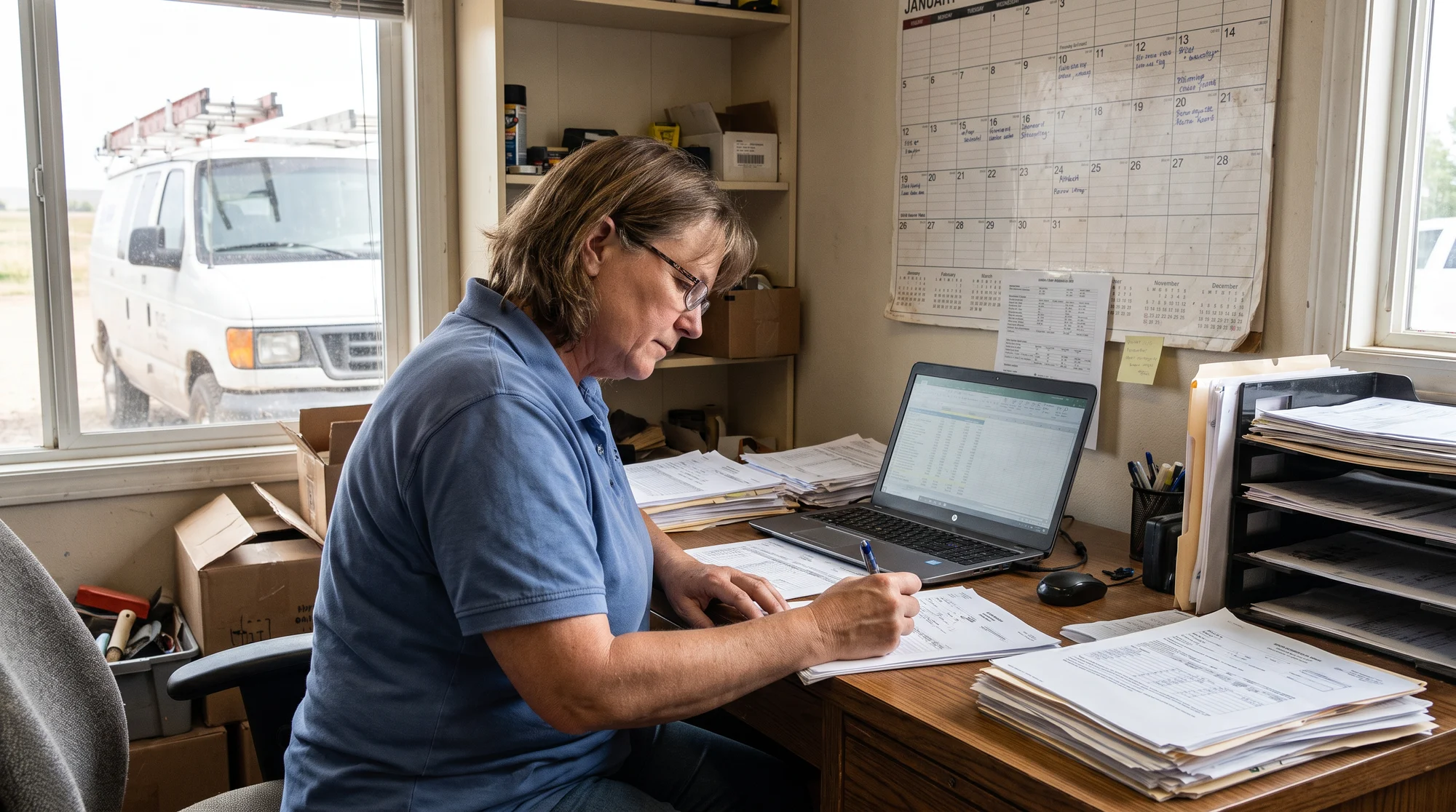
One person in the office who owns contract tracking: Whether that's you or your office manager, someone needs to own every open quote and unsigned agreement from walkthrough to first invoice.
Dedicated admin time on the calendar: Block out time twice a week to build proposals, follow up on unsigned contracts, and set up recurring schedules once deals close.
A clear tracker for every agreement: Use a spreadsheet or your field service software to see which bids are out, which contracts are waiting on a signature, and when recurring agreements are up for renewal.
Verified labor and supply costs: Check local wage benchmarks before you price the job so you don't bid yourself into a loss.
Proof of insurance and business registration: Commercial clients and platforms alike check your paperwork early. Both Right Cleaning Done LLC and Hello Cleaners require general liability insurance, reliable transportation, and a registered business or 1099 setup before you can take on contract work.
The 6-step sequence to write, send, and close a cleaning contract
You don't need a twenty-page legal packet to protect your cleaning company. You need a clear sequence that moves the client from the walkthrough to a signed agreement, plus a clause-by-clause template they can read in five minutes.
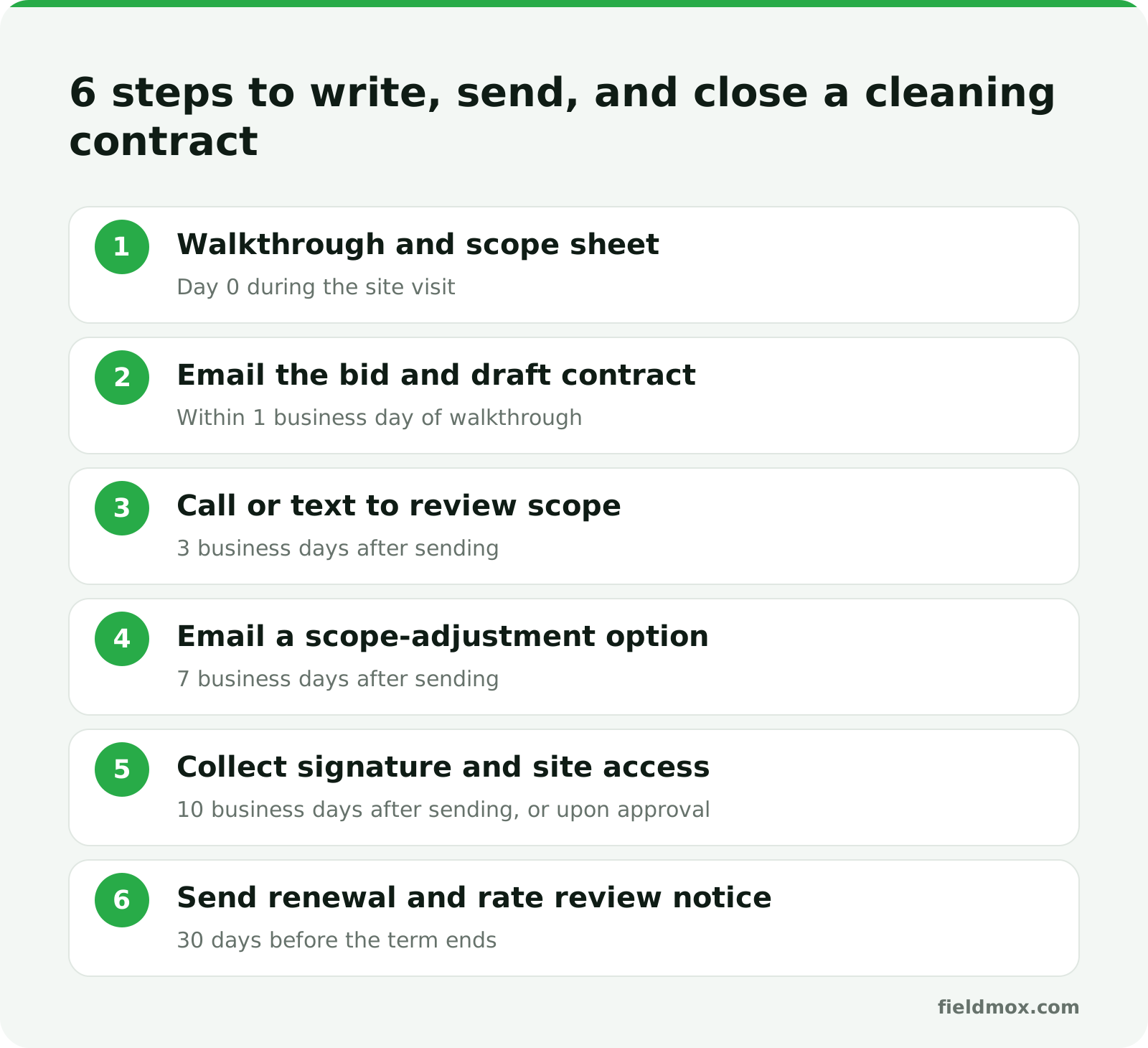
Follow these six steps for every recurring residential or commercial account. Replace the {placeholder} fields in the templates with your company and client details.
Step 1: On-site walkthrough and scope sheet, Day 0 during the site visit
Your goal during the walkthrough is to measure the space, count the fixtures, and separate standard recurring tasks from extra billable work. Never bid a recurring account sight unseen.
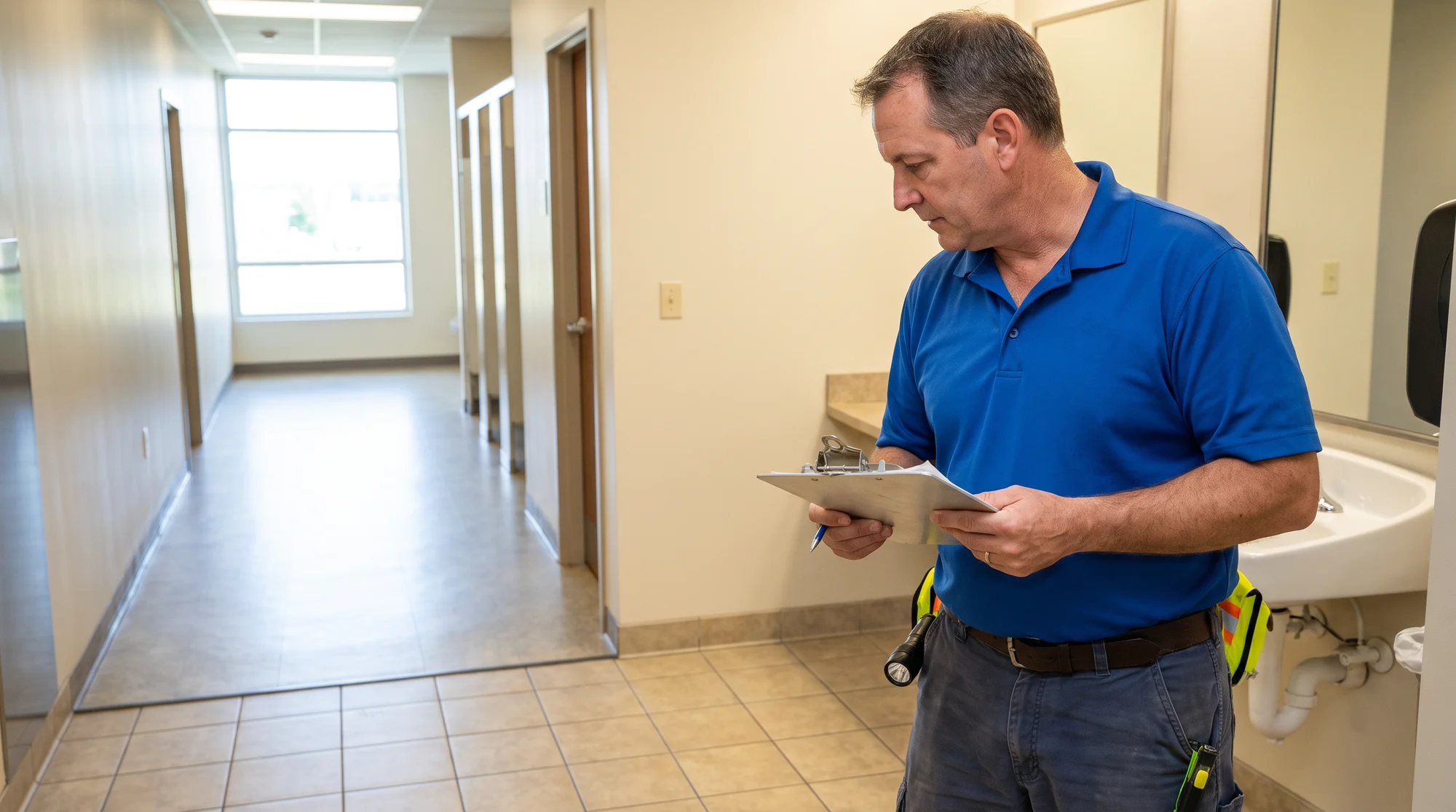
Walk every room with a checklist and note the square footage, floor types, and existing buildup. For multi-facility commercial bids, verify the total footprint across every building, just like CleanWork's Lyon County RFP where the listing text states a total of 45,700 sq ft across five county facilities. Ask the client whether you're restocking consumables (soap, liners, paper towels) or using their supply closet.
Step 2: Email the bid and draft cleaning contract, Within 1 business day of walkthrough
Your goal is to get the scope, frequency, pricing, and contract terms into the client's inbox while the walkthrough is still fresh. At this point, the client is comparing bids.
Send your proposal and the clause-by-clause contract together so the client sees what's included in the price and how the agreement works.
Subject: Cleaning proposal and service agreement for {client_name} at {service_address}
Body:
Hi {client_first_name},
Thank you for walking {service_address} with me yesterday. Below is our cleaning service agreement covering the exact scope, visit schedule, and pricing we discussed.
1. Parties and Service Sites
This Cleaning Service Agreement is entered into on {contract_start_date} between {your_company_name} ("Provider") and {client_name} ("Client") for the property located at {service_address}. (For multi-site commercial accounts, attach the full list of addresses and per-site prices.)
2. Scope of Work and Exclusions
Provider will perform the following tasks on each scheduled visit: {included_tasks_list_by_area}.
The following tasks are excluded from standard visits and require a separate written quote: {excluded_tasks_such_as_carpet_extraction_or_exterior_windows}.
3. Schedule, Frequency, and Site Access
Service will be performed {visit_frequency} on {days_of_week} between the hours of {start_time} and {end_time}. Client will provide keys, alarm codes, or badge access prior to the first visit. If Provider's crew arrives as scheduled and is locked out or turned away with less than {lockout_notice_hours} hours' notice, Client will be billed a lockout fee of {lockout_fee_amount}.
4. Supplies, Equipment, and Consumables
Provider will bring all standard cleaning chemicals, tools, and equipment required to complete the Scope of Work. Restocking of facility consumables (paper towels, toilet tissue, hand soap, trash liners) {is_or_is_not} included and will be {consumables_billing_method}.
5. Pricing, Invoicing, and Payment Terms
Client agrees to pay {price_amount} {billing_frequency_per_visit_or_per_month}. Invoices are sent {invoicing_schedule} and are due {payment_terms_upon_receipt_or_net_15_or_net_30}. Payments not received within {grace_period_days} days of the due date are subject to a late fee of {late_fee_amount_or_percent}, and Provider may pause scheduled visits until the account balance is cleared.
6. Quality Verification and Service Reports
Provider stamps arrival and finish times at the property and documents completed checklists and before-and-after photos via technician mobile devices. Client must report any missed items within {quality_report_hours} hours of a visit so Provider can inspect and correct the issue.
7. Insurance and Liability Provider maintains general liability insurance and will provide a Certificate of Insurance upon request. Provider isn't liable for pre-existing damage, normal wear and tear, or faulty fixtures on site.
8. Term, Cancellation, and Renewal
This Agreement begins on {contract_start_date} for an initial term of {initial_term_months} months. After the initial term, it renews {renewal_type_month_to_month_or_annually} at an adjusted rate of {annual_rate_increase_percent}% unless either party gives {cancellation_notice_days} days' written notice to cancel.
To approve this agreement and confirm your start date on {first_visit_date}, please reply with your confirmation or sign at {signature_link}.
Best regards,
{your_name}
{your_company_name}
Step 3: Call or text to review the scope, 3 business days after sending the contract
Your goal is to surface any pricing pushback or scope questions before the client goes quiet. By day three, they've read the number.
Pick up the phone and ask if the scope and visit days match what they had in mind. If the price is higher than their budget, don't cut your hourly rate. Offer to adjust the frequency (for example, moving from five nights a week to three) or move deep-cleaning tasks to a quarterly add-on.
Step 4: Email a scope-adjustment option, 7 business days after sending the contract
Your goal is to get a firm yes or no before the open quote piles up on your desk. If you haven't heard back after a week, the client is stalling on price or waiting on sign-off.
Send a short, polite email that reminds them of your crew's schedule availability and offers a smaller starter scope if budget is the blocker.
Subject: Checking in on cleaning schedule for {service_address}
Body:
Hi {client_first_name},
I'm following up on the cleaning agreement I sent on {proposal_sent_date} for {service_address}. We're building out our crew routes for {upcoming_month}, and I want to make sure we hold the {days_of_week} slot for you.
If the {visit_frequency} schedule is more than you need right now, I'd be happy to adjust the contract to {alternative_frequency} at {alternative_price} so you can see our crew's work first.
Let me know how you'd like to proceed, and I'll update the agreement today.
Best,
{your_name}
Step 5: Collect the signature and site access details, 10 business days after sending (or upon approval)
Your goal is to get the signed contract, payment method, and building access confirmed before the crew arrives. Don't put a tech on the schedule until the agreement is signed.
Confirm the alarm code, key drop location, parking rules, and billing contact email. Set the recurring visit schedule in your calendar so the job repeats automatically each week or month according to the agreement.
Step 6: Send the renewal and rate review notice, 30 days before the contract term ends
Your goal is to renew the account and adjust your pricing for rising labor and chemical costs without surprising the client. Don't wait until expiration week.
Check your job history and inspection reports to confirm your crew delivered every scheduled visit. Then send a formal renewal notice a full month before the contract rolls over.
Subject: Upcoming service renewal for {service_address} on {renewal_date}
Body:
Hi {client_first_name},
It's been a pleasure taking care of {service_address} over the past year. Per our service agreement, your contract is scheduled to renew on {renewal_date}.
To keep pace with current supply and labor costs while keeping the same crew on your property, your updated rate beginning {renewal_date} will be {new_price_amount} {billing_frequency} ({With_no_change_to_your_current_scope_or_with_the_updated_tasks_attached}).
If you'd like to add carpet care, floor scrubbing, or extra visits for the upcoming term, let me know by {response_deadline} and I'll include them. Otherwise, your schedule will continue uninterrupted.
Thank you for your business,
{your_name}
How do you manage cleaning contracts from quote to renewal?
If you follow a repeatable process for every residential and commercial account, you stop losing evenings to custom paperwork and stop losing money to unpaid extras. Here's the full method at a glance:
Walk the site with a room-by-room checklist so you never guess at square footage, restroom counts, or floor types.
Price labor and supplies from real numbers rather than cutting your rate just to beat a lowball bid.
Spell out inclusions, exclusions, and consumable supplies in plain language inside the contract.
Include a lockout fee and a cancellation notice window so your crew's route is protected from last-minute changes.
Require arrival stamps, checklists, and site photos on every visit so you have proof of service if a client questions an invoice.
Follow up at 3 and 7 business days on every open proposal, offering a reduced visit frequency instead of a discount if budget is tight.
Review every recurring agreement 30 days before renewal so your rates stay ahead of wage and material costs.
Which tools help you manage cleaning quotes, recurring contracts, and invoicing?
Once you have more than a few recurring accounts, tracking contract dates in Word documents and building next week's schedule on a whiteboard starts eating your evenings. Three categories of tools can take that admin load off your desk:
Spreadsheets and document templates: Google Docs, Word, and Excel let you write contracts and log renewal dates for free, though someone in the office still has to copy every accepted contract into the calendar and build every invoice by hand.
Accounting software: Platforms like QuickBooks Online handle your books, tax rates, and invoice tracking, and work best when paired with field software that pushes finished jobs over automatically.
Field service management software: Platforms such as Jobber, Housecall Pro, Workiz, and Fieldmox manage daily field operations. In Fieldmox, an AI copilot drafts quotes and service reports on every plan, plus next week's schedule, contract or monthly invoice batches, and reminders for open quotes and unpaid invoices on Pro, and your office reviews and sends everything. Recurring jobs schedule themselves from the agreement, invoices sync to QuickBooks Online, and payments land in Stripe.
When choosing a tool to run your cleaning contracts, check four things:
How it handles recurring visits and multi-site accounts: Make sure the system schedules weekly, monthly, or custom contract visits automatically and lets you price each commercial site separately.
What proof the technician app captures in the field: Look for time and location stamps on arrival and finish, room checklists, and photo capture so you can back up your contract work.
Whether the software reduces office typing: Check if your office staff has to build every quote, schedule, report, and invoice from a blank screen, or if a copilot drafts them for your team to review.
How user pricing scales as you add cleaners: Compare flat monthly tiers against per-seat plans so hiring three more cleaners for a new commercial building doesn't spike your software bill.
Frequently asked questions about cleaning contracts
Where can I find commercial and government cleaning contracts to bid on?
You can find commercial and government cleaning contracts on state and county procurement portals, local bid directories like CleanWork (which lists city and state RFPs, subcontract leads, and short-term rental turnovers), and by contacting commercial property managers directly. Watch for "Rebid expected" tags on public facilities so you can get on the vendor list before the current contract expires.
How much should I budget for labor when pricing an office cleaning contract?
Check local wage data for your exact market and role before you bid, because hourly employee pay and independent contractor rates differ cleanly. For example, ZipRecruiter data for Las Vegas shows an average hourly pay of $14.16 and a median wage of $13.78/hr ($12.70 at the 25th percentile and $15.05 at the 75th percentile) for office cleaning bid roles as of Nov 9, 2026, while independent contractor postings on Indeed run from $18–$22/hr at Red Rock Cleaning up to $23.65–$28.48/hr at Right Cleaning Done LLC and $23–$37/hr at Purified Cleaning Solutions LLC.
Do independent cleaning subcontractors need their own insurance and supplies?
Many cleaning contractor listings and platforms require 1099 subcontractors to carry their own general liability insurance and bring their own equipment and chemicals. Both Hello Cleaners and Right Cleaning Done LLC require contractors to provide liability insurance, reliable transportation, and all cleaning supplies, and Hello Cleaners also requires a smartphone for before-and-after photos.
What if a client wants to add extra rooms or carpet cleaning mid-contract?
Point to the Exclusions clause in your contract and send a separate one-off quote before your crew does the extra work. Specialty work carries different labor math, such as Dial Maintenance's Las Vegas carpet cleaning technician role paying $600 to $1,200 per week, so it should always be billed on its own ticket or added via a written contract amendment.