pressure washing business · 21 min read
How to Start a Pressure Washing Business in 2026: Costs, Pricing and Marketing
Start a pressure washing (power washing) business in 2026: real startup costs, licenses, insurance, equipment, pricing and the door-to-door marketing a 15-year-old used to reach $200K.
Thejas
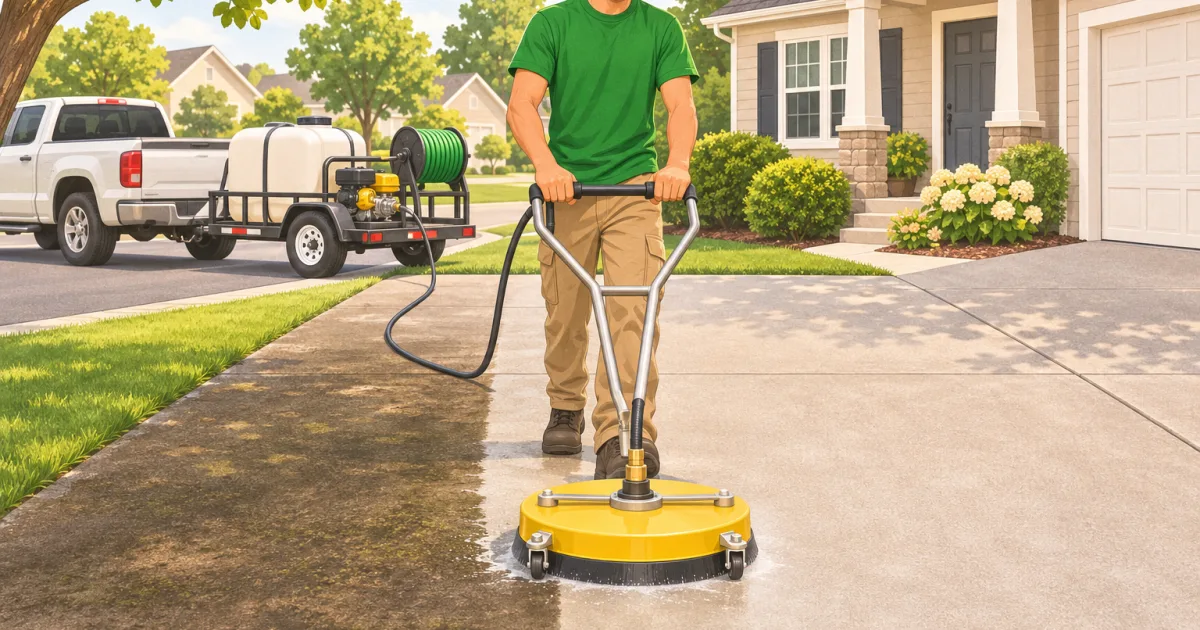
You can start a pressure washing business for $1,500 to $4,000, and in most of the US you don't need a special license to do it. The washing is the easy part. A YouTube video and a weekend teach you most of it. The hard part is getting customers, and the people who quit usually quit there, somewhere around the fortieth door.
This guide covers both halves: how to set the business up properly in 2026 (costs, paperwork, insurance, equipment, pricing), and how to market it. The marketing section draws on an interview with Henry, a 15-year-old in Connecticut who says his pressure washing and Christmas light business is on track for more than $200,000 in revenue this year, with three full-time employees. He's a useful example because he started with almost nothing: $100, a used pressure washer and a lot of doors.
There are four tools on the page: a startup cost calculator, a job price calculator, a door-knocking calculator and a launch checklist that saves your progress. They run in your browser and nothing is sent anywhere.
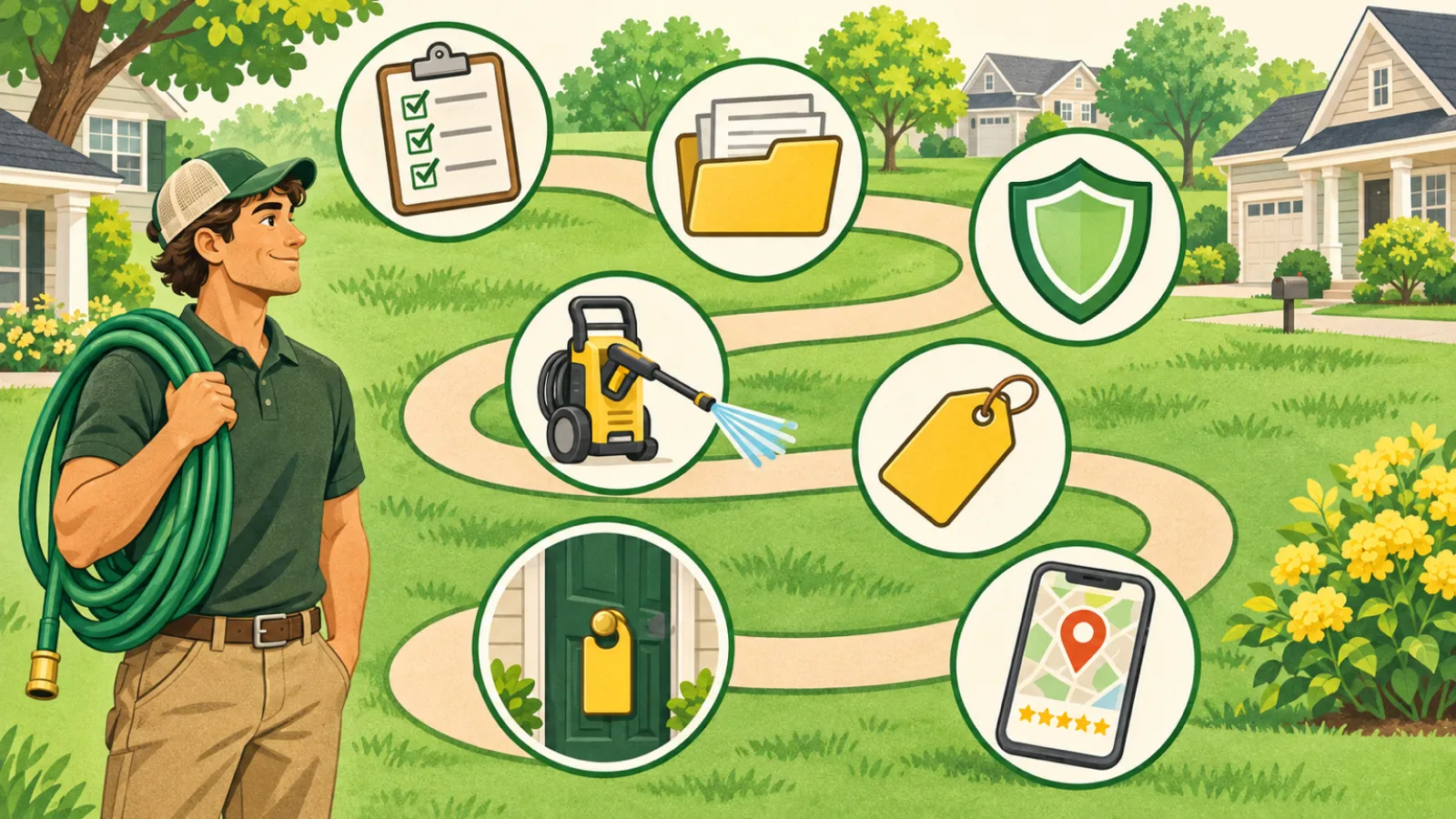
The short version
- Pick a few services, not ten. Driveways and concrete, house washes and decks cover most residential demand. Add roofs, commercial work or holiday lights later.
- Run the numbers first. Work out your startup cost, your job minimum and your price per square foot before you print anything.
- Form an LLC (or start as a sole proprietor), get a free EIN and open a business bank account.
- Get a local business license and check two things most guides skip: whether your state wants a contractor or pesticide license, and where your wash water is allowed to go.
- Buy general liability insurance before your first job. Expect about $61 to $75 a month.
- Buy a pro-grade machine (4 GPM or more), a surface cleaner and a soft wash setup. A used unit from Facebook Marketplace is fine to start, as Henry did.
- Knock doors. It's still the fastest way to your first 20 customers. Then let yard signs, reviews and referrals take over.
- Write every quote down, take deposits on big jobs and invoice the same day.
Pressure washing or power washing?
People search for both about equally (around 1,000 searches a month each for "how to start a pressure washing business" and "how to start a power washing business" in the US). Technically, power washing uses heated water and pressure washing uses cold water, but almost every customer uses the words to mean the same thing. Use whichever one people say in your area in your business name and on your Google profile, and mention the other in your service descriptions so you show up for both.
What a 15-year-old's $200K pressure washing business teaches you
In an interview with Cameron, a co-founder of Whop, Henry explained how he built the business. A few parts of his story are worth more than any equipment list:
- He started with $100. "I literally just took like 100 bucks and I bought like a pressure washer off Facebook Marketplace." He didn't plan anything. He picked pressure washing because other kids at his school were already doing it and making money.
- His first customer took about 150 doors. That first job paid $50, for a walkway. Today one of his door-knockers can knock about 20 doors and close a $1,000 or $2,000 job.
- His pitch is a script with five parts. An opening line, a first round of objection handling, a walk around the house, the price with a second round of objections, and the close. More on that below.
- Three million views didn't bring customers. One of his videos went viral and later ones reached 10 million plus. In his words, he's gotten about three jobs from social media in his lifetime. Customers come from his door-to-door team, referrals, ads, door hangers and yard signs. The videos are a separate income (platform payouts and brand deals), not a lead source.
- He protects his calendar. Customers can cancel free until 24 hours before the job, then it's a $50 fee. For bigger holiday lighting contracts he takes a 50% deposit before buying materials.
- He does two things, in different seasons. Pressure washing in the warm months and Christmas lights in winter. His main advice to people starting out: "Pick one thing and be really good at it," rather than offering landscaping, pressure washing, window cleaning and curb painting all at once.
- Things go wrong. His first partner (his best friend at the time) broke equipment and took money from the business account. Later he overdrew the account and had to cover $4,000 of payroll within 24 hours, which he did by collecting deposits. His lesson: don't go into business with friends without clear terms, and keep a cash buffer.
You don't need to be 15 or have a following to copy any of this. The business works the same way for a 40-year-old with a truck.
What it costs to start a pressure washing business
The machine is the biggest decision. Here's how the main setups compare:
| Setup | Upfront cost | Good for | Watch out for |
|---|---|---|---|
| Used gas pressure washer (2.5 to 3 GPM) | $200 to $500 | Testing the business, sidewalks, small driveways | Slow on big jobs; buy one you can hear start and run |
| New pro unit, 4 GPM, 4,000 PSI, Honda or similar engine | $1,000 to $1,600 | Most solo residential businesses | You still need a surface cleaner and soft wash pump |
| Belt-drive 8 GPM skid (no trailer) | $3,000 to $5,000 | Big driveways, commercial flatwork | Needs a water tank or a strong water supply |
| Full trailer rig with tank, reels and pumps | $7,000 to $15,000 | Crews, commercial accounts | Only worth it once your calendar is full |
Use the calculator to see your own number.
Pressure washing startup cost calculator
First-year cost for a one-person pressure washing business. 2026 typical prices; your quotes will differ.
Two things push the real cost up. The first is the vehicle: you need something that can carry or tow your gear, and a trailer setup needs a truck. The second is water. A 4 GPM machine needs a hose spigot that delivers at least 4 gallons a minute, and many homes don't. Test the customer's spigot with a bucket and a timer before you start, or carry a buffer tank.
Step 1: Choose your services
| Service | Typical US price | Method | Notes |
|---|---|---|---|
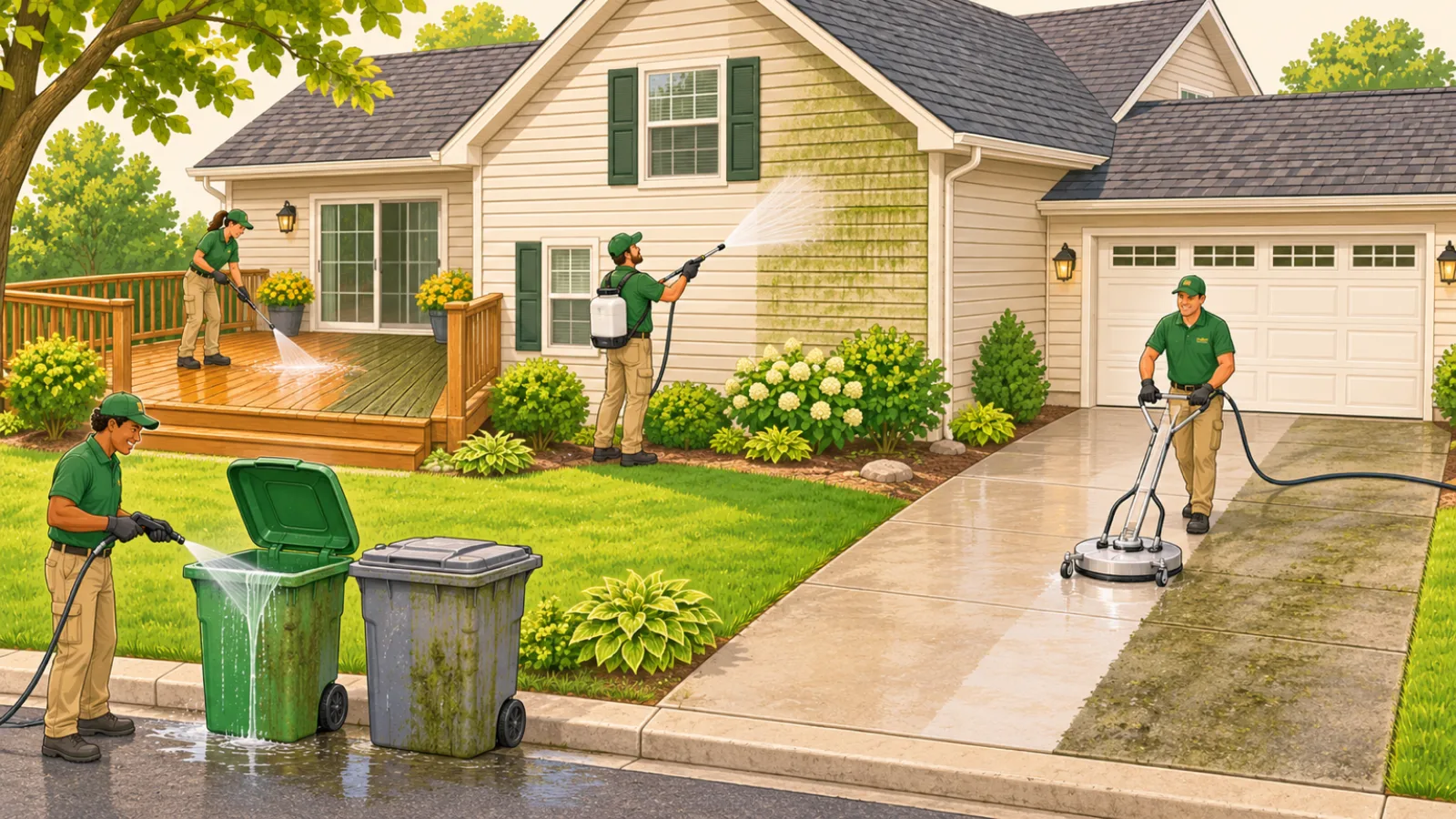
| Driveway, sidewalk, patio | $0.20 to $0.40 per sq ft ($150 to $400 a job) | Surface cleaner, then rinse | Easiest to learn, most visible before and after |
| House wash | $213 to $449 a home | Soft wash (low pressure + cleaning solution) | High pressure can damage siding and windows |
| Deck or fence | $0.35 to $0.60 per sq ft | Low pressure, wood-safe cleaner | Easy to gouge wood if you rush |
| Roof soft wash | $450 to $700 a roof | Soft wash only | Ladder and fall risk; check your insurance covers it |
| Commercial flatwork (storefronts, drive-thrus, dumpster pads) | $0.08 to $0.20 per sq ft, often monthly | Hot water helps with grease | Wastewater rules are stricter |
| Holiday light installation (winter) | $1,000 to $5,000+ a home | Ladders, clips, timers | Henry's off-season business; take deposits |
Price data: the Fieldmox pressure washing pricing calculator, HomeAdvisor and Fixr (2025).
Our advice: start with driveways, concrete and house washes. Learn soft washing before you touch a roof. Add one off-season service (holiday lights, gutter cleaning or window cleaning) once the first one is running smoothly. That's what Henry did.
Step 2: Pick a name, form an LLC and open a bank account
Name. Search your state's business name database, then Google the name with your city. Keep it simple and searchable: your town or your name plus "Pressure Washing" works. Henry's business name started as a placeholder, then a video went viral and he couldn't change it, so pick something you can live with.
LLC or sole proprietor. An LLC separates your personal assets from the business, which matters when you're working on other people's property with a machine that can strip paint. State filing fees run from about $50 (Arizona) to $300 (Texas), with yearly fees in some states ($800 minimum tax in California). You can also start as a sole proprietor with a DBA and form the LLC later, but do it before you hire anyone.
EIN and bank. Get a free EIN at IRS.gov (it takes about 10 minutes). Then open a business checking account and run every job through it. It also keeps things clear if you have a partner. Henry's first partner took money out of the shared business account, which is much easier to spot when every job runs through it.
Under 18? A minor usually can't sign contracts, open accounts or form an LLC alone in most states. A parent or guardian typically co-signs or holds the accounts. Henry's dad helped with the emails and admin side of his first business, a candy company he started at seven.
Step 3: Licenses, permits and wastewater rules
Most states don't have a pressure washing license, but that doesn't mean you need nothing.
- Local business license. Almost every city or county wants one. It usually costs $50 to $150.
- Contractor license in some states. California is the main example: jobs over $1,000 (labor and materials) need a license from the Contractors State License Board. A few other states require home improvement registration. Check with your state's contractor board.
- Pesticide applicator license for soft washing. Some algae, moss and mold treatments are registered pesticides. If you apply them for pay, your state's department of agriculture may require a commercial applicator license. Plain sodium hypochlorite house washing usually doesn't, but check before you sell "roof treatments" or "mold killer."
- Wastewater. This is the one most new owners never hear about. Under the Clean Water Act and local stormwater rules, wash water with soap, chemicals, oil or paint chips isn't allowed to run into storm drains, because they go straight to rivers and lakes. Many cities (San Diego and Alachua County, Florida, for example) publish best practices: cover nearby storm drains, send water onto grass or gravel where you can, and recover and dispose of it on commercial jobs. Buy a storm drain cover or mat ($50 to $150). Commercial clients will ask about this.
Step 4: Get insurance before the first job
General liability is the minimum. It covers damage to a customer's property (a cracked window, etched glass, stripped paint, a dead plant bed) and injuries to other people. Insureon and TechInsurance put the average for pressure washing businesses at about $75 a month for a $1 million per occurrence / $2 million aggregate policy, and MoneyGeek's 2026 figure is about $61 a month.
Read the policy for two things:
- Care, custody and control exclusions. Many policies don't cover damage to the thing you're working on (the siding you're washing). Ask for it to be included.
- Roof and height work. Some policies exclude work above a certain height. If you plan to soft wash roofs, make sure you're covered.
Add commercial auto if you tow a trailer or drive between jobs for the business, and workers' comp as soon as you hire (it's required in nearly every state once you have employees). Many commercial clients and HOAs will ask for a certificate of insurance before they give you a job, so having one ready helps you win work.
Step 5: Buy the right equipment
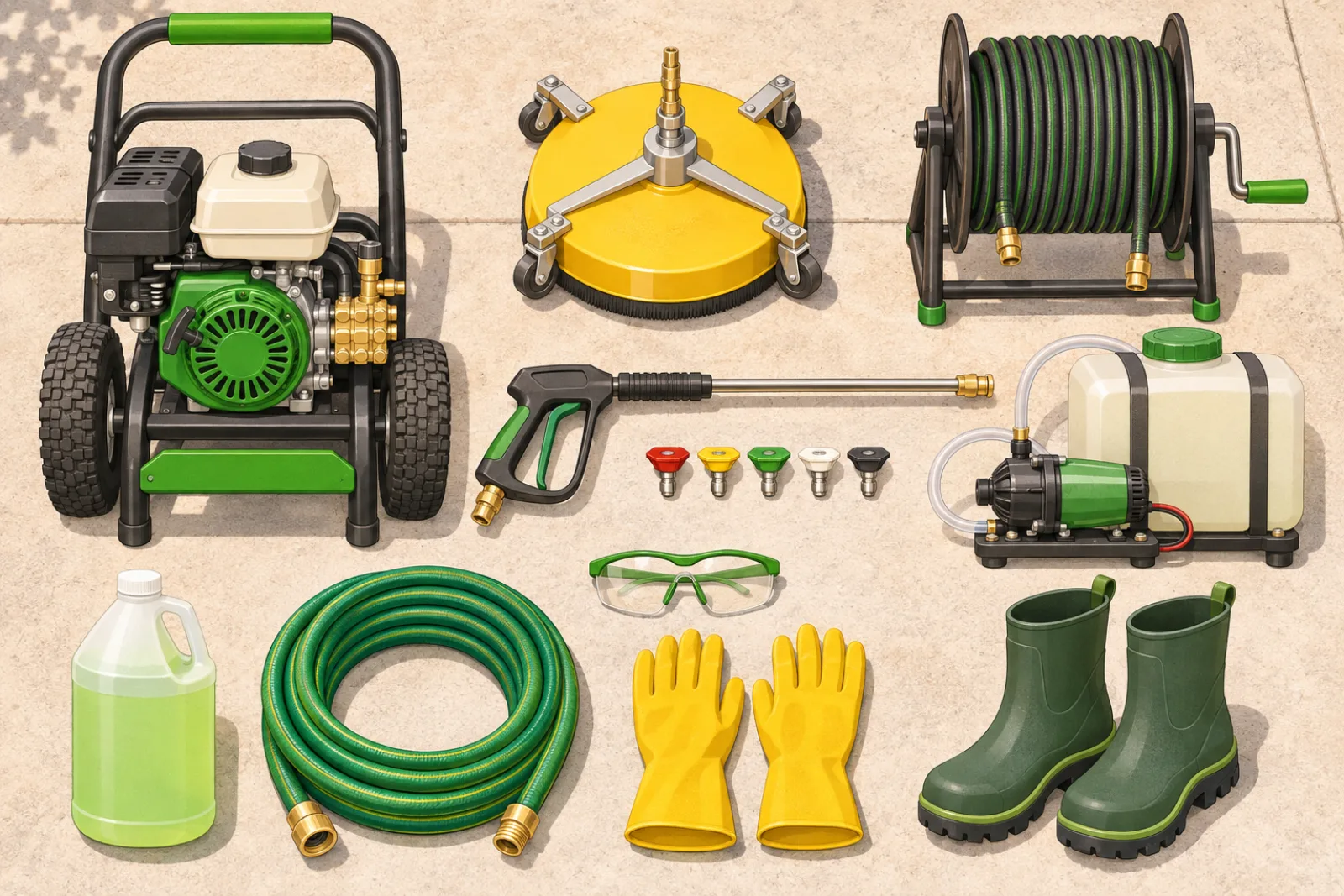
Pressure washer: look at GPM before PSI. Pressure (PSI) breaks dirt loose. Flow (gallons per minute) carries it away, and flow is what makes you faster. A 4 GPM, 4,000 PSI machine with a reliable engine is the standard for a serious residential business. Consumer electric units (1.5 to 2 GPM) are too slow to make money.
Surface cleaner. A 16 to 20-inch rotary surface cleaner cleans flat concrete several times faster than a wand, without the "zebra stripes" that make a driveway look worse. This is the first upgrade to buy.
Soft wash setup. A 12-volt pump, a chemical tank and a long hose let you apply cleaning solution at low pressure for siding and roofs. Houses are washed with chemicals, not force. Blasting vinyl siding with high pressure forces water behind it and can crack it.
Hoses, nozzles and fittings. 100 to 200 feet of pressure hose on a reel, a wand, quick-connect nozzles (0°, 15°, 25°, 40° and a soap tip) and spare O-rings.
Chemicals. Sodium hypochlorite (pool chlorine) diluted for house washing, a surfactant to help it stick, a degreaser for oil stains and a rust remover. Read the safety data sheets. Rinse plants before and after, and never mix bleach with acids or ammonia.
Safety gear. Safety glasses, chemical-resistant gloves and non-slip boots. A pressure washer can cut skin. Never point the wand at a person, and never use a 0° tip anywhere near someone's body.
Practice on your own property first. Henry learned door-to-door sales from YouTube and Instagram videos, and you can learn the washing the same way. Then do your own driveway, a family member's house and a neighbor's patio for free or at cost, and photograph every one of them.
Step 6: Set your prices
Most pressure washing businesses price by the square foot for flat surfaces and by the job for houses, with a minimum charge (usually $150 to $200) that covers setup, driving and cleanup. Price by the job, not by the hour. As you get faster, hourly pricing pays you less, while job pricing pays you more.
Pressure washing price calculator
A starting quote from typical US rates. For a full cost-based price (pay, overhead, margin), use the detailed pressure washing pricing calculator.
A few rules that protect your margin:
- Measure, don't guess. Driveway area is length × width. Siding area is roughly the house perimeter × wall height. Use Google Maps' measuring tool to quote from home.
- Bundle. "House wash plus driveway plus walkway" for one price is easier to say yes to than three separate quotes, and you only set up once.
- Never discount to win a door. Offer a neighbor deal instead ("we're already on your street Thursday"), which is honest and fills your route.
- Put it in writing. Send a quote with the price, what's included, what isn't (oil stains that won't fully come out, paint that's already peeling) and your cancellation policy. A free pressure washing service contract template covers the terms.
For a price based on your own costs (pay, overhead, chemicals and the margin you want), use the full pressure washing pricing calculator.
Step 7: How to market a pressure washing business
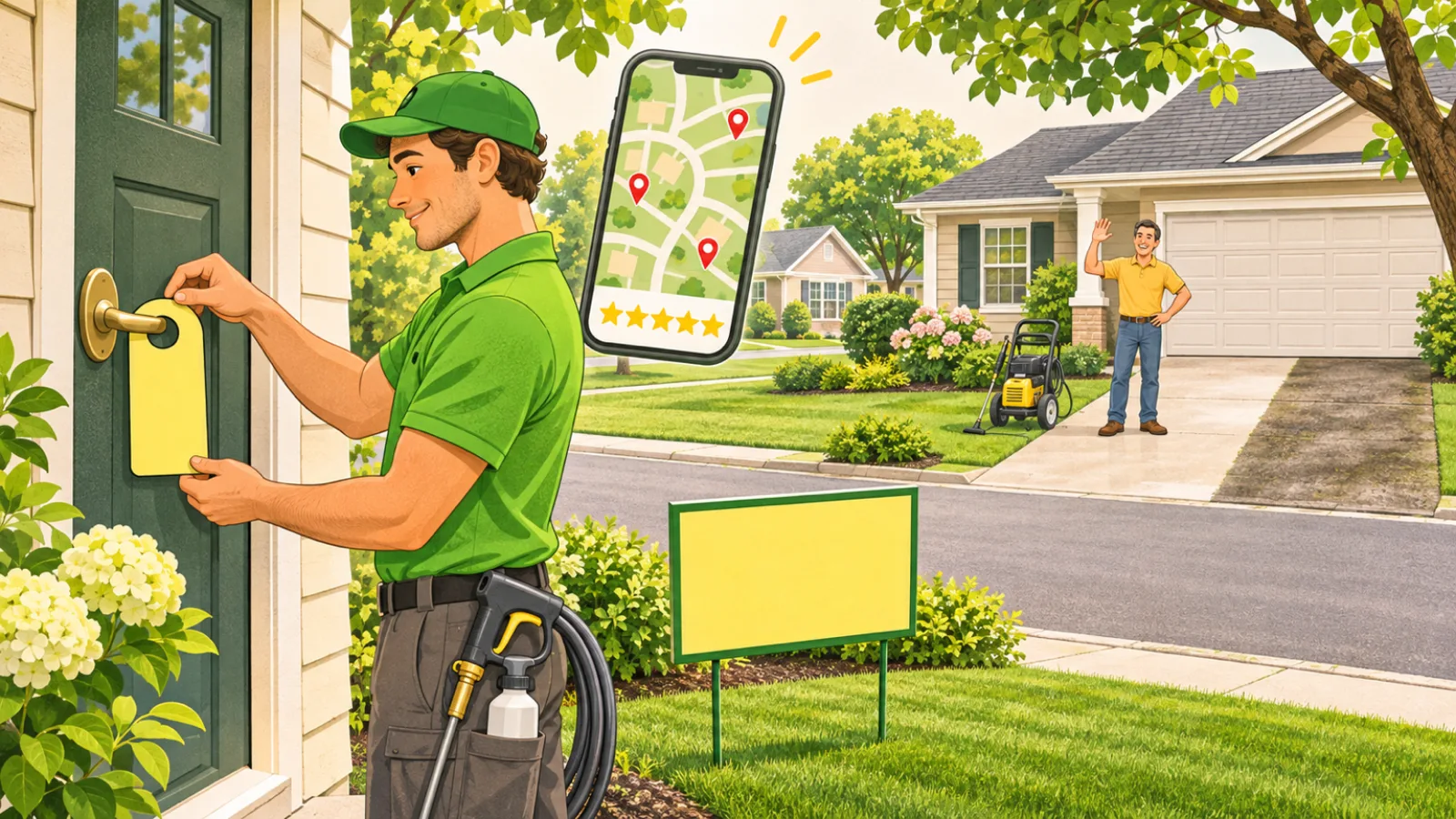
Henry ranks his customer sources like this. For pressure washing and window cleaning: door-to-door first, then referrals, then ads and everything else. For holiday lights: yard signs first, then word of mouth, then ads. Here's how to use each one.
1. Door-to-door, with a script
Door-knocking costs nothing but time, and it works because the proof is right there: the customer's own dirty driveway. Henry's script has five parts:
- The opener. Short and local. "Hey, how's it going? We're helping out one of your neighbors down the street with their pressure washing, and noticed your driveway's got some buildup on it too."
- First round of objections. "Not interested", "I'm busy", "I need to ask my husband." Have an answer ready for each.
- The walk-around. Offer a free price. "I'll walk around the house, get you a quick price and meet you back here in 30 seconds."
- The price and second round of objections. Give one clear number. Handle "that's too much" with the bundle or the neighbor deal, not a discount.
- The close. Get them on the schedule, collect their name, address, phone and email, and confirm the cancellation policy.
Here's how Henry handles "I need to talk to my husband": agree with them ("If I had a house this nice, I'd want to talk to my husband too"), point out that price will come up in that conversation anyway, and offer to get them the price now. He also warns against pushing too hard: customers pressured into a yes are the ones who cancel.
Door-knocking calculator
How many doors stand between you and your monthly goal. Henry's first job took about 150 doors. With a practiced pitch his team now closes a $1,000 to $2,000 job from about 20.
Door-knocking tips that work:
- Knock where you just worked. The streets around a finished job are your best territory. Ask the customer if you can mention their name.
- Go between 4 and 7 pm on weekdays and late mornings on Saturdays, when people are home.
- Leave a door hanger when no one answers, with a before-and-after photo and your number.
- Check local rules. Some towns require a solicitor permit. Respect "No Soliciting" signs.
- Don't quit at door 40. Henry says it might take 300 to 500 doors to get your first customer, and that most people who tell him they can't find customers quit after 20 to 50. If an area isn't working, move to another one.
2. Yard signs and door hangers
Put a yard sign in every customer's lawn for a few days after the job (ask first). A clean driveway with a sign next to it advertises to every car on the street. Door hangers ($0.10 to $0.25 each) work best on the 20 to 30 houses around a job: "We just cleaned your neighbor's driveway on Oak Street. Want yours done this week?"
3. Google Business Profile and reviews
Set up a free Google Business Profile as a service-area business (you can hide your home address), list each service separately and add before-and-after photos every week. Then ask every happy customer for a review the same day, with a direct link. Reviews are what get you into the map results for "pressure washing near me." See how you compare with local competitors using the free Fieldmox business grader.
4. Referrals
Word of mouth is Henry's number two source for both businesses. Make it deliberate: give each customer a referral card or text with $25 or $50 off their next job for each neighbor who books. Neighbors talk about clean driveways.
5. Facebook groups, Nextdoor and before-and-after posts
Post your best before-and-after photos in local community groups (read the rules on self-promotion first). Pressure washing is one of the most satisfying things to watch, which is why it does so well online. But be realistic about what content does. Henry has millions of followers and says only about three jobs ever came from his videos, because his audience lives all over the country. Local groups beat national reach for finding customers.
6. Paid ads, once you have reviews
Google Local Services Ads and Facebook ads targeted at your service area can work, but they work much better once you have 20 or more reviews. Start with a small budget and track how much each booked job costs you.
7. Commercial accounts and brand deals
Restaurants, gas stations, HOAs and property managers need regular cleaning of dumpster pads, drive-thrus and sidewalks, often monthly. Henry's biggest break was a collaboration with a fast-food chain where he cleaned one of their locations on video. You don't need a viral video for this: walk into local businesses with photos of your work and offer a first clean at a fair price.
8. Seasonal add-ons
Pressure washing slows down in winter in most of the US. Holiday light installation (Henry's second business), gutter cleaning and window cleaning keep your crew busy and your customers coming back. Run them as separate seasons so each one gets your full attention.
Step 8: Hire help and keep the business running
Once you're turning work down, hire. Henry now has two full-time employees doing the jobs and one full-time door-knocker, while he focuses on sales and runs the business from his desk. A few things to get right:
- Hire employees properly. Use W-2 payroll and workers' comp. Calling a helper a "contractor" when you set their hours and supply the equipment can get you fined.
- Train them on your own property first, especially soft washing and chemical safety.
- Keep a cash buffer for payroll. Pay comes out every week or two whether customers have paid or not. Henry once overdrew his account and had to find $4,000 in a day. One month of payroll in the bank prevents that.
- Take deposits on big jobs (Henry takes 50% on holiday lighting contracts) and charge a late cancellation fee.
As soon as you have more than a few jobs a week, keep quotes, the schedule, customer details and invoices in one place instead of a notes app and your camera roll. You'll know who still owes you money, which streets you've already knocked, and which customers to remind about their yearly wash.
Your launch checklist
Pressure washing business launch checklist
Tick things off as you go. Your progress is saved in this browser.
- Plan
- Paperwork
- Gear
- Marketing
- Run it
Frequently asked questions
How much does it cost to start a pressure washing business?
About $1,500 to $4,000 for a solo setup with a new 4 GPM machine, a surface cleaner, a soft wash pump, insurance, an LLC and basic marketing. You can start for under $1,000 with a used machine, as Henry did with $100, and upgrade from your first jobs. A full trailer rig costs $7,000 to $15,000 and only makes sense once you're busy.
Do I need a license to start a pressure washing business?
Usually just a local business license. A few states, such as California for jobs over $1,000, require a contractor license, and applying some algae or moss treatments for pay can require a pesticide applicator license. Check with your city, your state contractor board and your state department of agriculture.
Is pressure washing a profitable business?
Yes. Material costs are low (chemicals and fuel are a small share of each job), so a solo operator who stays busy keeps a large part of every job, often 50% or more before paying themselves. The main costs are equipment, insurance, your vehicle and your time spent finding customers.
How much can you make with a pressure washing business?
A solo operator doing 3 to 4 jobs a day at $250 to $400 can bring in $15,000 to $25,000 a month in peak season. Most US markets are seasonal, so plan for slower winters or add a winter service. Henry's business, with a door-knocking team, two technicians and holiday lights, expects more than $200,000 in revenue this year.
How do I get my first pressure washing customers?
Knock doors in neighborhoods with driveways and older siding, starting near people you know. Offer to do a few jobs at cost for friends and family in exchange for before-and-after photos and reviews. Set up a Google Business Profile on day one, and put a yard sign in every customer's lawn.
Can a teenager start a pressure washing business?
Yes. Henry started at 14 with a used machine and a friend. A parent or guardian will usually need to co-sign contracts, open the bank account and form the LLC, and you'll need a way to get your equipment to jobs. Start with walkways and driveways, learn soft washing before you touch a house, and wear safety gear every time.
What equipment do I need to start a pressure washing business?
A gas pressure washer of at least 4 GPM, a surface cleaner, 100 to 200 feet of pressure hose, a wand with nozzle tips, a 12-volt soft wash pump with a chemical tank, cleaning chemicals, a storm drain cover and safety gear. You also need a vehicle that can carry or tow it all.
What's a good name for a pressure washing business?
Something short, easy to spell and searchable, usually your town or your name plus "Pressure Washing" or "Exterior Cleaning." Check that the name is free in your state's business registry and that the domain and social handles are available before you print anything.